To view the technical documents, please fill out the form below. We will get back to you as soon as possible and you can log in and review with the password given by us. If you have a password, you can log in and continue by clicking "Sign In".
You can access the documentation by logging in from this area with the password given to you.
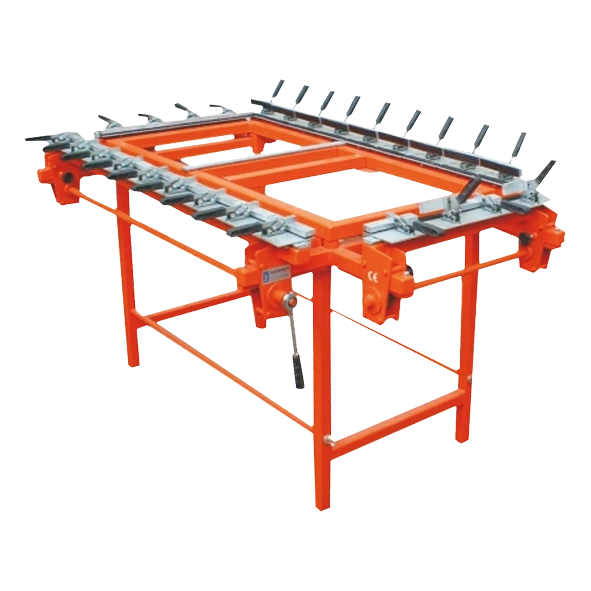
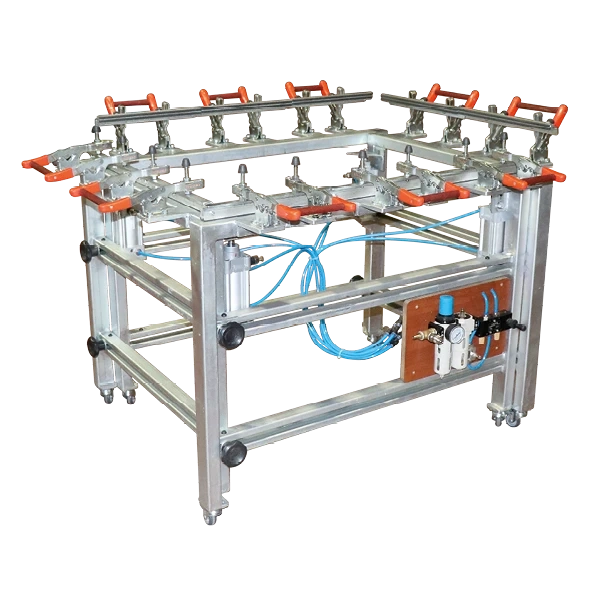
High-permeability sieve-cloth conditioning station
High-precision mechanical process equipment for mounting onto the frames (boxes) of plansifters in flour and semolina mills the sieve cloths (mesh fabrics) that directly determine grading performance — with high tear resistance and geometrically flawless tension. Owing to the independently controlled four-corner tensioning design that prevents the mesh apertures from deforming, it provides maximum micronised permeability on the sieve decks and sustainable sieving efficiency.
WORKING PRINCIPLE
Modular box bedding and cloth laying — rigid positioning and centring: the square sieve box is rigidly placed into the machine’s adjustable centring seat, all four corners of which are movable; the raw cloth chosen for the classification mesh count is laid over the box as a uniform curtain. High-grip clamp matrix and tensioning — mechanical simultaneous clamping: the cloth edges are gripped and locked by high-strength mechanical clamps positioned at the table’s four corners; with the mechanical system the cloth begins to be stretched outward linearly and precisely along four axes. Square-aperture stability and permanent bonding — fixing and integration: when the targeted high tension index is reached, the mesh apertures’ exact square geometry is locked; the tensioned mesh is permanently fixed onto the box surface with industrial adhesives (“liquid weld”) or pneumatic-staple systems and made ready for cutting.
KEY ADVANTAGES
- Maximum sieve permeability and square-aperture stability: The mesh tension degree directly affects sieving quality; on insufficiently or asymmetrically tensioned cloths the apertures lose their square form and shrink, taking permeability to the lowest level; our system ensures the mesh is tensioned homogeneously at every point and offers maximum fluid permeability.
- “Multi-Size” table with independently movable four corners: All four corners of the table are movable and have a telescopic slide mechanism; this offers the flexibility to adjust within seconds to any sieve-box size of the different brands and models used in the plant.
- “Dual-Frame” standard twin-box connection infrastructure: In the standard model, to double the operational speed and cloth-renewal turnover during plant stoppages, one or two boxes can be connected at once and tensioned simultaneously.
- Custom manufacture beyond size limits: From laboratory-type small boxes outside standard sieve sizes to the huge boxes of large-scale special grading units, custom manufacture in various sizes can be carried out per the plant’s request.
ENGINEERING NOTE
The mechanical mesh-tensioning table is the most critical mechanical calibration station that manages flour quality and yield stability behind the scenes in flour mills. Bonding the sieve cloth to the box at low tension causes the mesh to sag under the weight of the flour mass during the plansifter’s circular oscillation, the flour particles to pile up on the sieve surface and, ultimately, the yield to drop. The linear tensioning strength of the mechanical clamps keeps the aperture mesh count equal over the whole surface without disrupting the molecular structure of the mesh fibres and guarantees the standardisation of the plant’s flour-semolina quality.
 TR
 RU
 ES